Screen 5,000+ NYSE and NASDAQ companies across 31 fundamental metrics. Backtest up to 10 years of point-in-time data, then turn the result into a research report a fund would publish. Free to start. $220 a year for everything.
No account, no email, no download. Every filter, threshold, rebalance rule, and cost assumption is printed on the page.
Joel Greenblatt's screen, run honestly from 2017 to 2026 with delisted companies kept in. A plain S&P 500 index fund returned 15.28% a year over the same decade.
Read the run →Benjamin Graham's five filters, run on point-in-time data from September 2016 to September 2026. Level with the S&P 500 after seven years, then 1.6 points a year behind by the end. The index returned 15.35% a year.
Read the Graham run →Quality at a Fair Price over the same decade. In the index's up months it gained 73 percent as much, and in its down months it lost 70 percent as much. It trailed the S&P 500 by 3.86 points a year.
Read the quality run →If a tool will not show you its losses, you are reading marketing.
Three starting points, rebuilt every morning against point-in-time fundamentals. Same engine your account runs. Pick one and read the curve.
Answering "would this strategy have actually worked?" requires clean data, honest timestamps, and real risk math. Until now, each came with a wall in front of it.
A single Bloomberg Terminal seat lists at $31,980 a year in 2026, and even retail platforms put their best tools behind $39 to $79 a month. Serious research tooling was priced for people whose employer pays the bill.
Most free backtesters quietly cheat twice. They apply financials weeks before the filing became public, and they test only the companies that survived to today. Both hand you a number no real portfolio would have produced.
The honest alternative was building it yourself: Python, a data subscription, and weekends of debugging survivorship quirks. Most investors never make it past the setup.
SledgeKey exists to take the walls down. All three.
The same loop an institutional research desk runs every morning: screen, construct, evaluate, project. Click through each step below.
The AI Copilot translates natural language into structured filters across all 31 fundamental metrics. Prefer precision? Set every threshold yourself with distribution-aware sliders.
Decide how the strategy actually trades. SledgeKey supports six weighting schemes, four rebalance frequencies, position caps, and transaction cost modeling on every run.
Every run reports the metrics an allocator would ask for: risk-adjusted returns computed with real treasury rates, capture ratios computed Morningstar's way, and full drawdown analysis.
The Monte Carlo engine resamples your strategy's realized monthly returns with a stationary block bootstrap, preserving momentum and volatility clustering, and projects 5,000 alternative futures over the next five years.
Look-ahead bias and survivorship bias each quietly move backtested results away from what a real portfolio would have earned, and in our own runs the second has cut both ways. Most free tools commit both. Here is exactly what SledgeKey does differently.
Most tools timestamp fundamentals at the fiscal period end. From January 1st their simulation already "knows" Q4 earnings, roughly eight weeks before the 10-K was filed. That is information no investor had, priced into every trade.
Where most tools apply Q4 data
Where SledgeKey applies it, when the 10-K became public
Most tools build their history from companies listed today, silently erasing every name that delisted or failed along the way. A universe with the exits removed gives every strategy a number it never earned. Erasing the failures flatters it, erasing the buyouts does the opposite, and a survivor-only tool cannot tell you which happened to yours.
And one detail most tools skip: risk-adjusted ratios use real 3-month treasury rates from your backtest window, not an assumed constant. Headline Sharpe and Sortino use the average rate over the period; rolling Sharpe uses the rate prevailing in each window. Small detail, honest math.
An RIA team would spend half a day assembling this in Bloomberg and Excel. SledgeKey generates it in under a minute: a short summary and a 9-section research PDF and an 11-sheet workbook, written and charted from your exact run.
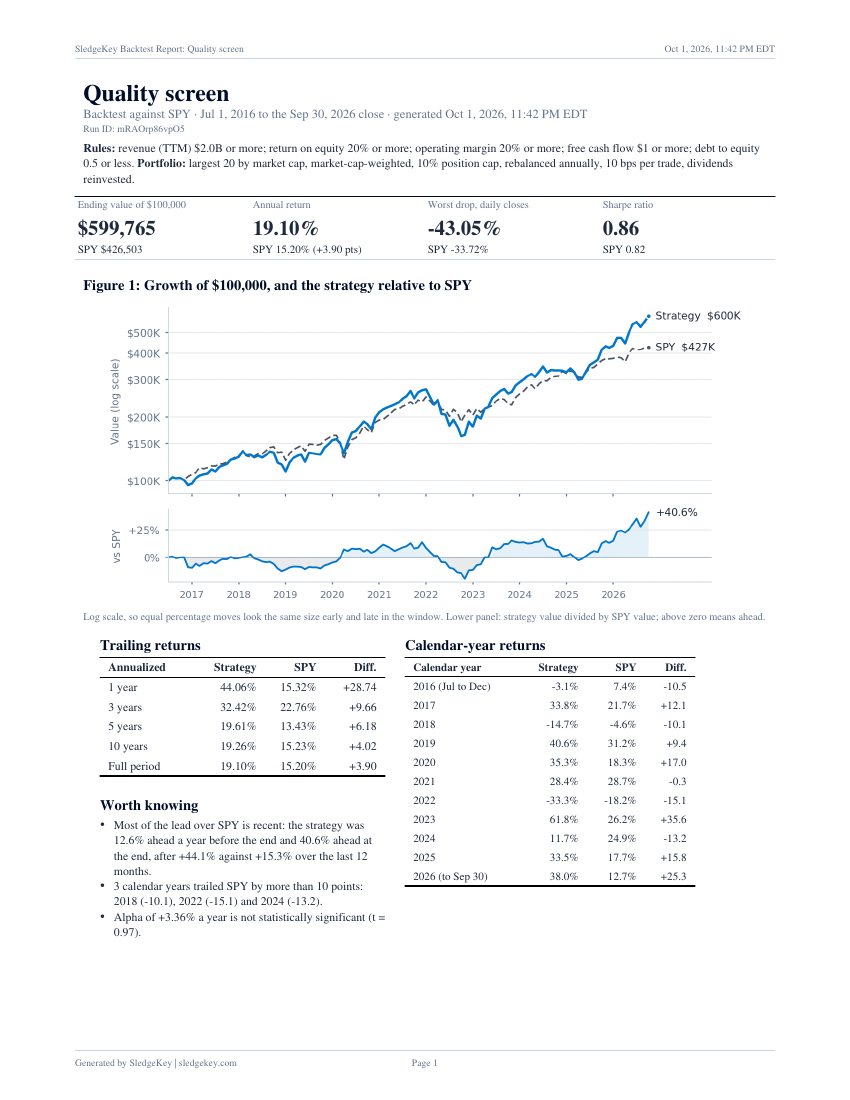
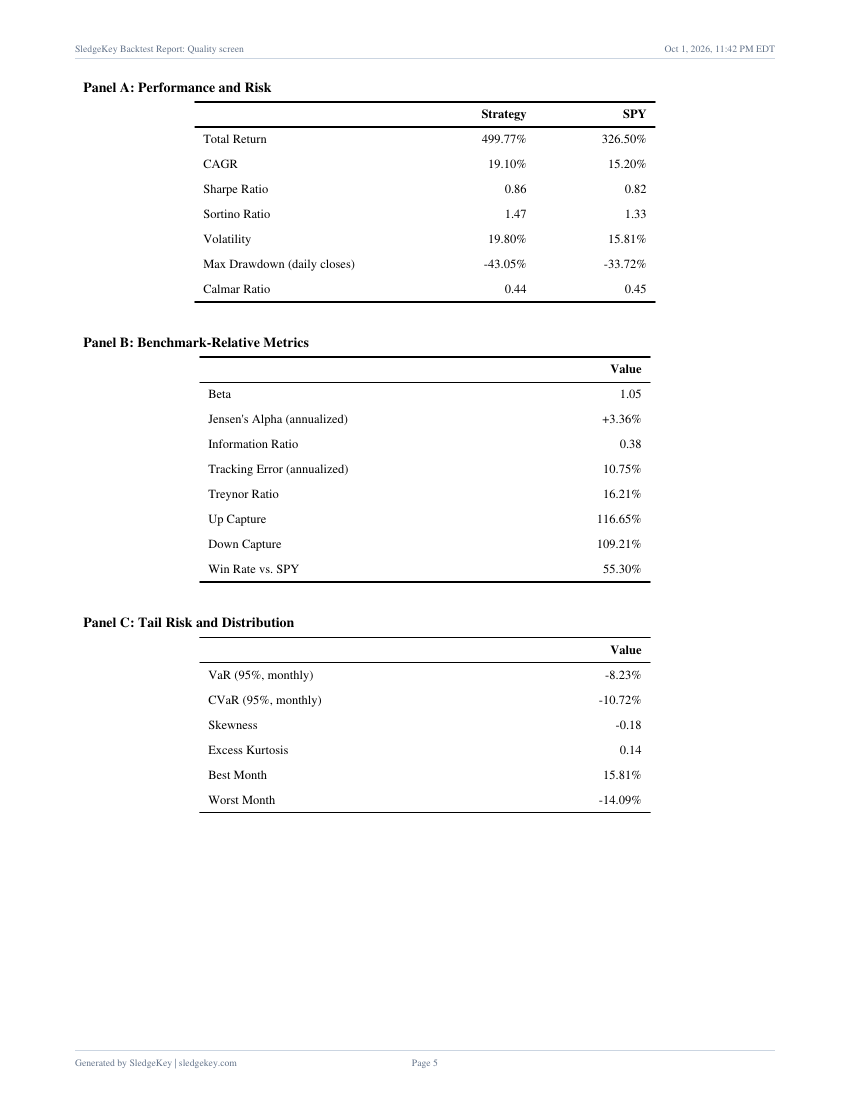
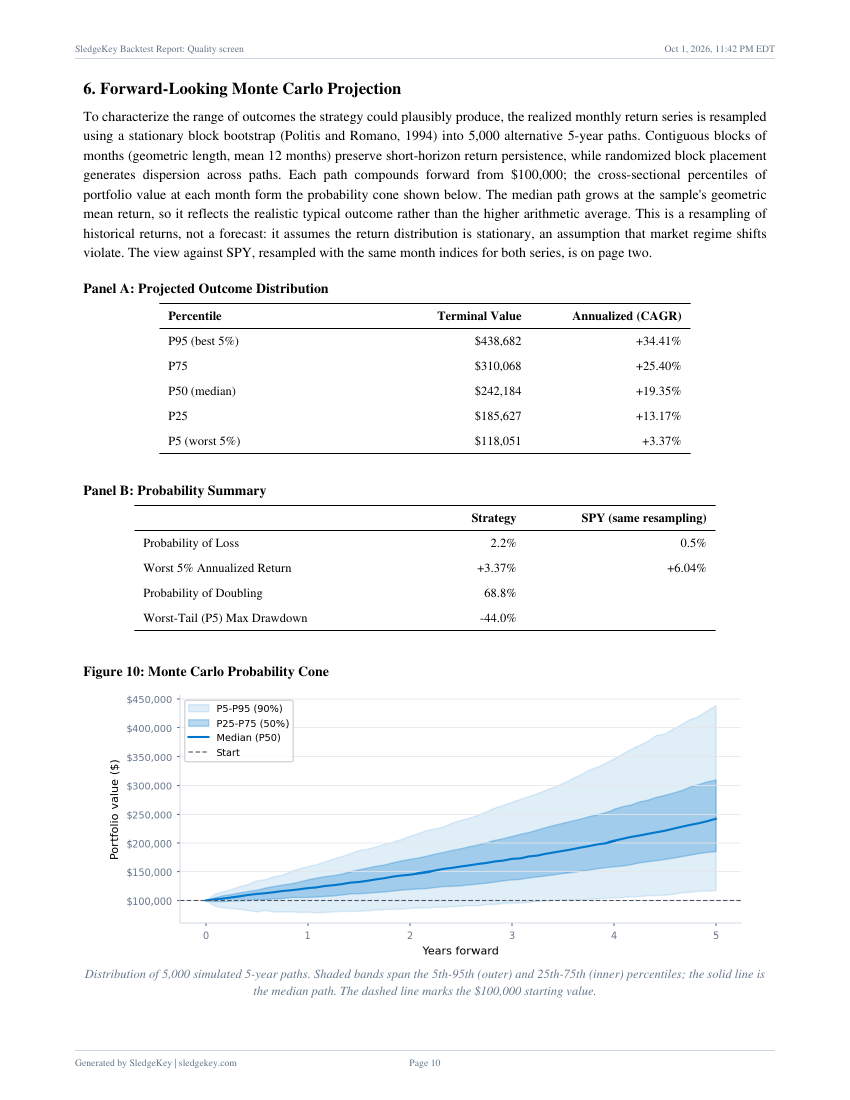
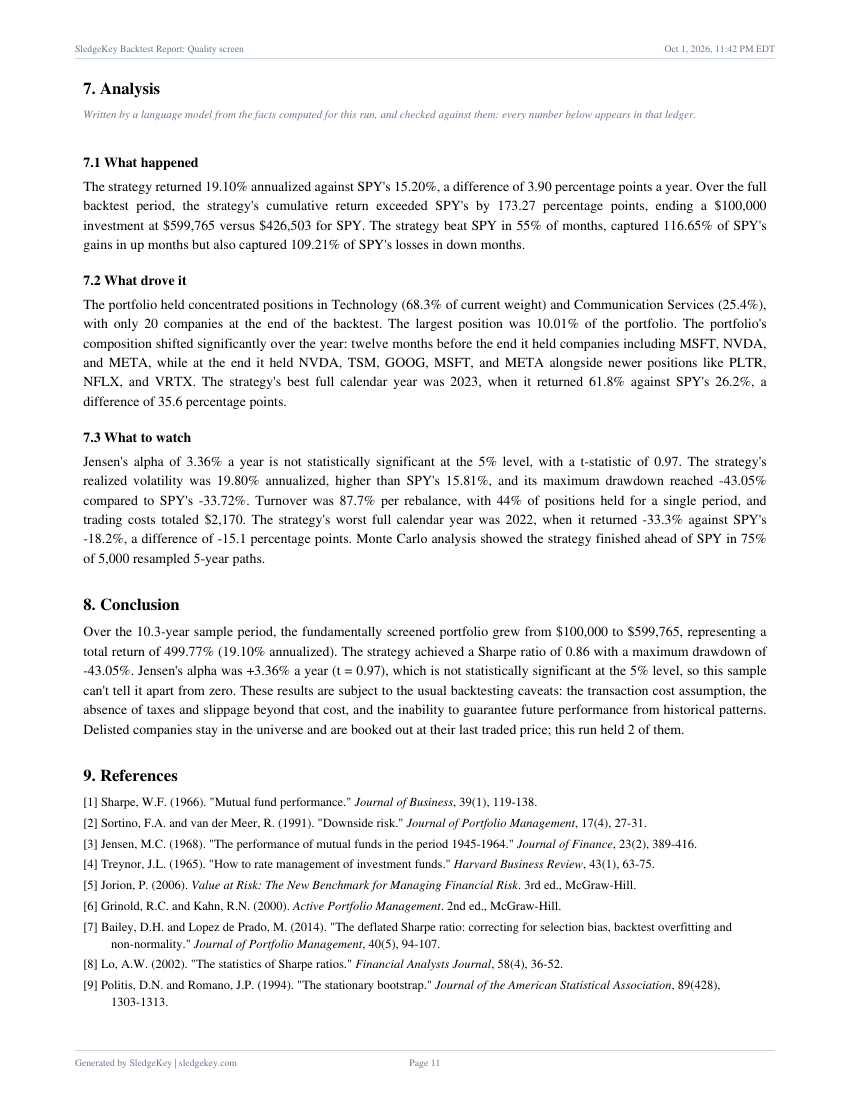
Introduction, data and methodology, empirical results in three metric panels, portfolio construction, risk decomposition, Monte Carlo projection, AI analysis, conclusion and references. Ten figures, a summary up front and a data integrity appendix at the back.
Setup, performance metrics, monthly returns, daily values, every trade, holdings at each rebalance, calendar-year returns, drawdown episodes, rolling 12-month figures, sector allocation and Monte Carlo fan data.
The analysis section is written by a language model from the facts computed for your run, then checked against them. In this sample it says the 3.36% a year of alpha is not statistically significant at the 5% level. Your own runs get the same treatment.
Here is what a year of institutional-grade research tooling costs in 2026.
Published 2026 list prices. SledgeKey+ costs less than one percent of a Bloomberg seat.
I am not a bank. I am one investor who wanted to know whether his ideas actually held up, and got quoted five figures a year for the privilege of finding out.
So I built the tool I wanted: clean point-in-time data, risk math done the way the textbooks say, and a report at the end that I would not be embarrassed to show a professional. No growth team decided the price. It is what I would have been happy to pay.
If something is wrong, you are talking to the person who can fix it. Literally: aaron@sledgekey.com comes straight to me.
Commercial-grade financial data covering NYSE and NASDAQ listed operating businesses, updated daily. The universe deliberately excludes SPACs, ETFs, mutual funds, and trusts, because backtesting against non-operating vehicles produces noise, not signal.
Every fundamental data point is tagged with the date its SEC filing became public, and backtests only use data on or after that date. A company's Q4 numbers do not exist to the simulation until the day they were actually filed. The universe also retains companies that later delisted, so strategies are tested against the market as it was, not just the survivors. Together these prevent look-ahead and survivorship bias, the two most common ways a backtest ends up reporting a number nobody could have earned.
Yes. It is not a trial, it does not expire, and signing up does not ask for a credit card. You get the full screener, the AI Copilot, and 2-year point-in-time backtests indefinitely. SledgeKey+ exists for people who want the full decade of history, hedging, Monte Carlo, and publishable reports.
Yes. Billing is handled through Stripe with a self-serve portal. Cancel in two clicks, no email, no phone call, and you keep access through the end of your billing period.
A short summary (the strategy against the S&P 500 by year, the current portfolio with its screen check, and a skill check with the alpha t-statistic and a Deflated Sharpe ratio) followed by a 9-section PDF in the style of an academic finance paper: abstract, methodology, three panels of institutional performance metrics, risk decomposition, portfolio construction detail, Monte Carlo projection, fact-checked AI analysis, and references, with ten figures. Plus an 11-sheet Excel workbook with the underlying data, including the daily values, the trade log and live formulas that recompute the headline metrics. Download the sample and judge it yourself.
No. SledgeKey is a research tool, not an advisor. It shows you how a strategy would have behaved historically and how it might distribute going forward. What you do with that evidence is your decision, and past performance does not guarantee future results.
Yes. New subscribers get 7 days free. A card is required so the subscription can continue without interruption, but nothing is charged on day one, and the exact first-charge date is shown on the checkout screen before you enter card details. Cancel before that date and you pay nothing. This is separate from the free Starter plan, which never expires and never asks for a card.
Portfolio123 is the only other tool doing point-in-time, survivorship-free screen backtesting, and it is a serious product built for quantitative professionals. Its Screener plan is $25 a month and its Pro plan is $83 a month. SledgeKey+ is $22 a month or $220 a year, so price is not the real difference. The output is. Every SledgeKey+ backtest exports a 9-section research PDF and an 11-sheet Excel workbook that recomputes its own headline numbers, with protective-put hedging and a 5,000-path Monte Carlo projection already in it. If you need custom ranking systems, a full formula language, and simulated live portfolios, Portfolio123 does more. If you want an honest point-in-time backtest you can hand to someone else and defend number by number, that is the gap SledgeKey+ fills.
Yes. Students with a school email ending in .edu get the full SledgeKey+ for $119 a year, or $12 a month. You sign up with your school address and go straight to student checkout. See how student pricing works.
We check your school email once a year. When you are no longer a student, or after four years, your plan moves to the standard SledgeKey+ price of $22 a month or $220 a year. We will tell you before that happens, so nothing changes without notice.
Screen smarter, test against honest data, and put real evidence behind your conviction.